Understanding Series vs. Parallel Circuit Design in LED Strings
One of the most common questions we get from our customers is:
“Why does the entire string of lights go out if the first bulb fails?”
The answer lies in how the circuit is designed, and whether it uses series or parallel connections. Let’s explore both types of circuits and their impact on the functionality of LED string lights.
Series Circuit Design
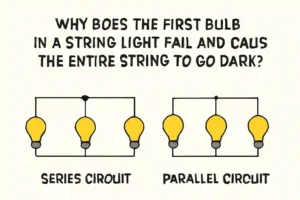
In a series circuit, the bulbs are connected one after another, with the current flowing through each bulb sequentially. If one bulb fails, the current cannot pass through, and the entire string of lights will go out.
Advantages of Series Circuit Design
Simplicity: Series circuits are relatively simple to design and manufacture, keeping production costs low.
Energy Efficiency: Suitable for smaller light strings where power consumption is relatively low.
Disadvantages of Series Circuit Design
Single-Point Failure: A failure in one bulb can cause the entire string to stop working, which can be troublesome when diagnosing and fixing the problem.
Safety Risks: If a bulb short circuits or the circuit is overloaded, it can affect other bulbs, potentially leading to electrical malfunctions or hazards.
Parallel Circuit Design
In a parallel circuit, each bulb has its own independent current path, so if one bulb fails, the other bulbs will continue to light up without disruption.

Advantages of Parallel Circuit Design
No Impact from Single-Point Failure: If one bulb fails, the rest will remain on, making maintenance and repairs much easier.
Stability: Parallel circuits are ideal for large, complex displays, providing more stable and reliable lighting systems.
Disadvantages of Parallel Circuit Design
Complexity: Parallel circuits are more complicated to design, requiring additional wiring, connectors, and control components. This increases manufacturing costs.
Power Distribution Issues: If not designed properly, the power supply may not distribute evenly, potentially causing some bulbs to fail.
⚖️ Summary
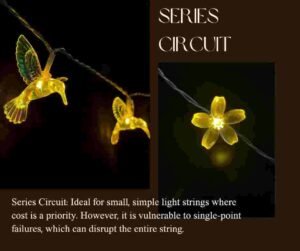
Series Circuit: Ideal for small, simple light strings where cost is a priority. However, it is vulnerable to single-point failures, which can disrupt the entire string.
Parallel Circuit: Better suited for larger, more complex lighting displays. While more expensive and complicated to design, it ensures that the failure of one bulb won’t affect the others, making it a more reliable option for big installations.
Both circuit types have their strengths and weaknesses, and the choice between the two largely depends on the scale and complexity of your lighting project.