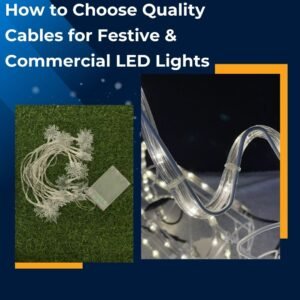

When buyers evaluate festive or commercial LED lighting, most attention goes to appearance, light effect, and price. However, in real projects, cable quality often determines safety, stability, and product lifespan.
Whether you are sourcing for retail programs, commercial displays, or large-scale outdoor projects, understanding cable materials helps you avoid hidden risks and make smarter purchasing decisions.
1. How to Tell If a Festive Light Cable Is Good Quality:
5 Key Factors
1) Copper Conductor Quality
The conductor is the core of any cable.
• Recommended: Pure copper or high-copper-content conductors•
Potential risks: Copper-clad aluminum (CCA) or mixed metals
Lower copper content means higher resistance, which can lead to:
• Excess heat generation
• Voltage drplays, conductor quality should never be compromised.
2) Wire Gauge (AWG)
op and uneven brightness
•Shorter product lifespan
For commercial and long-hour disCommon wire sizes in festive lighting include:
• 18 AWG
• 20 AWG
• 22 AWG
For long runs, outdoor installations, or project-based lighting, thicker wire gauges are strongly recommended.
Cables that are too thin may cause:
• Unstable brightness
• Faster aging
3) Outer Jacket Thickness & Uniformity
A reliable cable should feel:
• Full and well-padded
• Flexible, not stiff
• Smooth, without bubbles or thin spots
Poor-quality jackets are often:
• Too thin
• Hard or brittle
• Prone to cracking over time
The outer jacket is your first line of protection against environmental stress.
4) Safety & Compliance Certifications
For B2B and project lighting, certifications are critical:
• UL
• CE
• RoHS
• IP rating (for outdoor use)
Without compliant cables, complete lighting sets may struggle to enter:
• Large retail chains
• Supermarkets
• Municipal or commercial projects
5) Matching the Cable to the Application Environment
Cable selection should be based on usage conditions, not just price:
• Indoor vs. outdoor use
• Normal temperature vs. cold climates
• Dry vs. rainy or snowy environments
The best cable is not the most expensive one—it’s the one designed for the right scenario.

2. Understanding Different Cable Types for Festive Lighting
Copper-Core ConductorsKey advantages:
• Stable conductivity
• Low heat generation
• Long service life
Best suited for:
• Commercial-grade festive lighting
• Long operating hours
• Engineering and project ordersCommonly used in:
• Premium festive lights
• Shopping malls and municipal projects
This is the preferred option for B2B buyers focused on reliability.
PVC Cable (Most Common Choice)Advantages:
• Cost-effective
• Good insulation performance
• Easy to process and mass-produceLimitations:
• Can become stiff in low temperaturesRecommended for:
• Indoor decorations
• Temperate climates
• Seasonal retail displays
PVC cables offer good value, but cold resistance should always be considered.
Rubber Cable
Advantages:
• Excellent flexibility
• Strong resistance to bending and pulling
• Better weather resistance than PVCConsiderations:
• Higher cost compared to PVCIdeal for:
• Long-term outdoor installations
• Event projects requiring repeated setup and removal
• Applications where flexibility is essential
Often chosen for durable, project-grade lighting solutions.

Cold-Resistant CableKey features:
• Remains flexible at temperatures from -20°C to -40°C
• Resistant to cracking and jacket splitting
Best applications:
• North America, Northern Europe, and Russia
• Winter outdoor streetscapes
• Tree lighting and commercial plazas
For cold-climate projects, this type of cable is a practical necessity
rather than an upgrade.
Final Thoughts
Cable quality is not a visible feature—but it directly affects safety, durability, and customer satisfaction. For wholesalers, retailers, and project buyers, choosing the right cable specification helps reduce after-sales issues and ensures long-term performance across different markets.
If you’re evaluating festive or commercial lighting for different environments, understanding cable options is one of the most effective ways to protect your investment.